

Mini-fellowships

Mini-fellowships
GREENIN has funded four Mini Fellowship projects to support early career researchers and practitioners in developing innovative research, strengthening collaborations, and advancing knowledge on indoor greening and healthy indoor environments.
To explore all four Mini Fellowship projects, including researcher profiles, project summaries, blogs, videos and project updates, scroll down below.
Mini-fellowships
Meet our GREENIN fellows, a cohort of early-career leaders helping shape the future of indoor greening through collaborative, cross‑sector research.

Host institution: University of Surrey
Host: Professor Prashant Kumar
Project Title – Human-Centred Evaluation of Indoor Greenery for Thermal Comfort and Indoor Environmental Quality
Jorge Ignacio Soto Parejas, PhD Candidate
University College London (Picture here)
Summary – This Mini Fellowship aims to investigate how indoor greenery can improve thermal comfort, perceived indoor environmental quality (IEQ), and occupant wellbeing in residential buildings through a human-centred, data-driven approach. The project combines computer vision, environmental sensing, behavioural analysis, and machine learning to evaluate the relationship between indoor plants, environmental conditions, and occupants’ responses.
The fellowship will develop scalable, non-invasive methods for monitoring indoor greenery in real homes, integrating RGB imagery with environmental sensor data to identify greenery characteristics and their impact on comfort and perceived air quality. Occupant behaviour and adaptive responses will also be analysed to better understand how people interact with indoor green environments under different conditions. The project will further establish multimodal analytical models to identify key greenery features associated with improved comfort and wellbeing, ultimately producing practical evaluation frameworks and evidence-based guidance to support healthier indoor environments and future indoor greening strategies.
Blog Update - CLICK HERE
Final Report - CLICK HERE

Host institution: UK Centre for Ecology & Hydrology
Host: Professor Laurence Jones
Project Title – Modelling and Optimising Window-Side Indoor Greenery for Particulate Pollution Mitigation
Ziyue Peng, PhD Candidate
Heriot-Watt University (pictured here)
Summary – This Mini Fellowship explores how window-side indoor greenery can reduce particulate pollution exposure in residential buildings while improving indoor environmental quality. The project combines computational modelling, environmental analysis and interdisciplinary collaboration to investigate the mechanisms through which indoor plants influence airflow, particle deposition and indoor air quality.
The fellowship examines how plant species, placement, window-opening configurations and airflow patterns affect particulate matter (PM₂.₅) removal in naturally ventilated homes. By integrating expertise from environmental engineering, ecology and horticultural science, the project aims to establish an evidence base for optimising indoor greenery as a nature-based solution for healthier indoor environments. The outcomes will contribute practical recommendations for residential building design and provide scientific evidence to support future indoor greening guidance and policy development.

Host institution: University of Surrey
Host: Professor Prashant Kumar
Project Title – Investigating Indoor–Outdoor Green Interfaces to Support Healthy Ageing Environments
Hangchuan Wei, PhD Candidate
University College London (pictured here)
Summary – This Mini Fellowship investigates how indoor–outdoor green interfaces, including balconies, windows and threshold spaces, can improve indoor environmental quality (IEQ) and support healthier living environments for older adults. The project combines IoT sensing technologies with data-driven environmental analysis to evaluate how greenery at building boundaries influences air quality, light, acoustics and occupant wellbeing.
The fellowship will deploy environmental sensors to monitor key indoor and outdoor parameters, including particulate matter (PM₂.₅), carbon dioxide (CO₂), illuminance and noise levels. Python-based data analysis will be used to assess how threshold greenery modifies environmental conditions and enhances indoor–outdoor interactions. Working closely with the GREENIN Network, the project will also develop an initial Sensory Green Audit Protocol to support future research and evidence-based design of healthy residential environments for ageing populations. The fellowship will strengthen interdisciplinary collaboration between building science, environmental monitoring and healthy ageing research while providing practical guidance for future indoor greening strategies.

Host institution: University of Surrey
Host: Dr Hao Sun
Project Title – Exploring the Impact of Indoor Greening on Pupil Attendance, Engagement and Wellbeing in an Air-Filtered Classroom
Nathalie Pearson
Founder of Safe Air Schools UK and Principal Advocate (pictured here)
Summary – This GREENIN Mini Fellowship investigates the potential contribution of indoor greening to pupil attendance and staff-perceived pupil engagement and wellbeing in an air-filtered classroom, while monitoring changes in indoor and outdoor environmental conditions, including PM₂.₅, CO₂, temperature, humidity and noise.
The fellowship combines field observations with environmental monitoring and assessment to explore the potential contribution of indoor greening to healthier educational environments. A key element of the research is the Hayling Study, conducted in collaboration with The Hayling College, which investigates the addition of indoor greening to an air-filtered classroom and its association with pupil attendance, staff-perceived engagement and wellbeing. Indoor and outdoor environmental conditions, including PM₂.₅, CO₂, temperature, humidity and noise, will be monitored during a baseline period and throughout the intervention.
Through collaboration with the GREENIN Network, the fellowship aims to strengthen the evidence base for nature-based indoor interventions and generate practical insights to support healthier educational environments, informing future research, policy and practice.
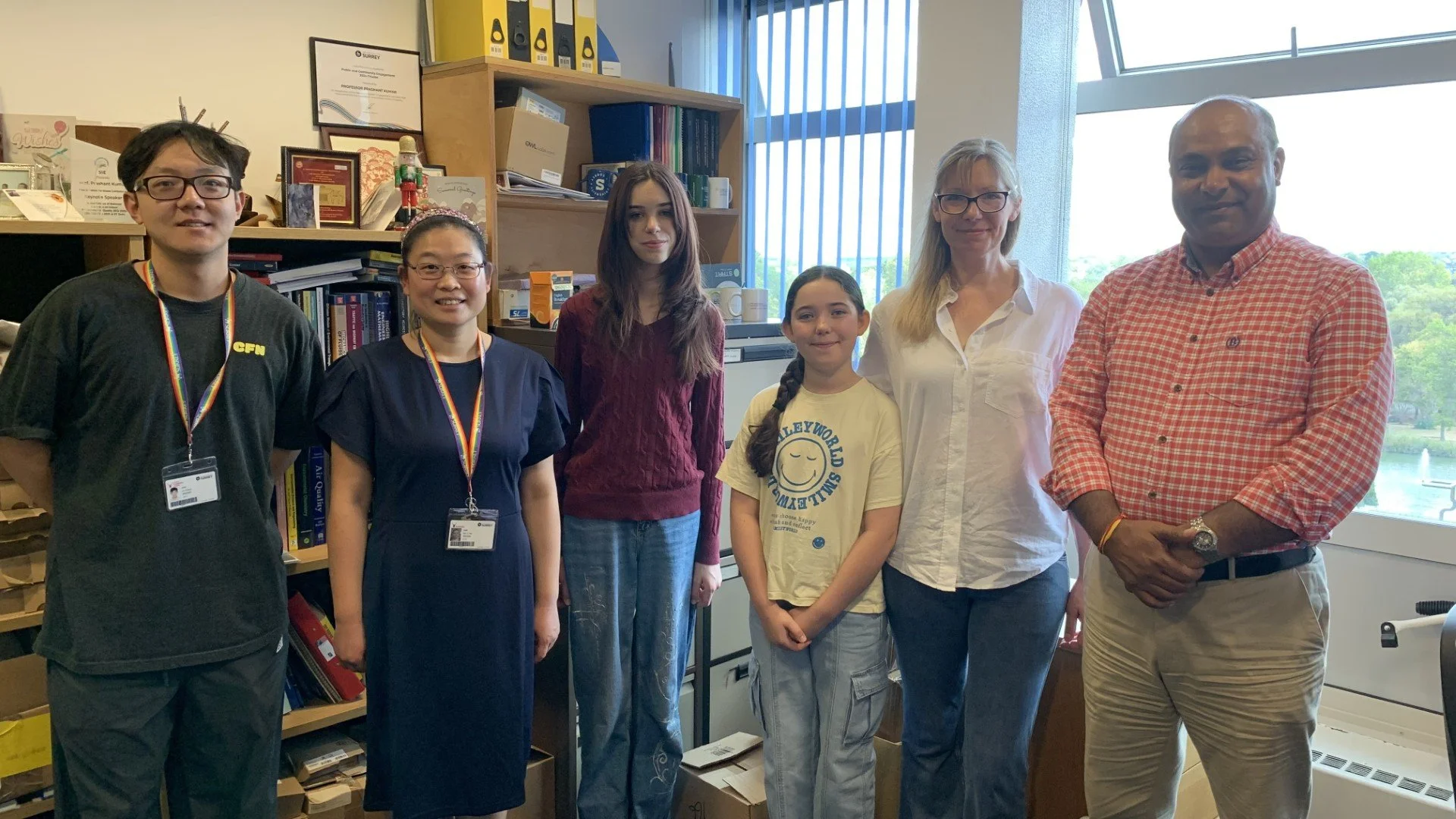
Nathalie met with Professor Prashant Kumar, Dr Hao Sun and the GREENIN team to discuss the next steps for her Mini Fellowship project, including monitoring school environments.
Her work helps connect research with real-world action to create healthier indoor environments.
There are no upcoming events at this time.